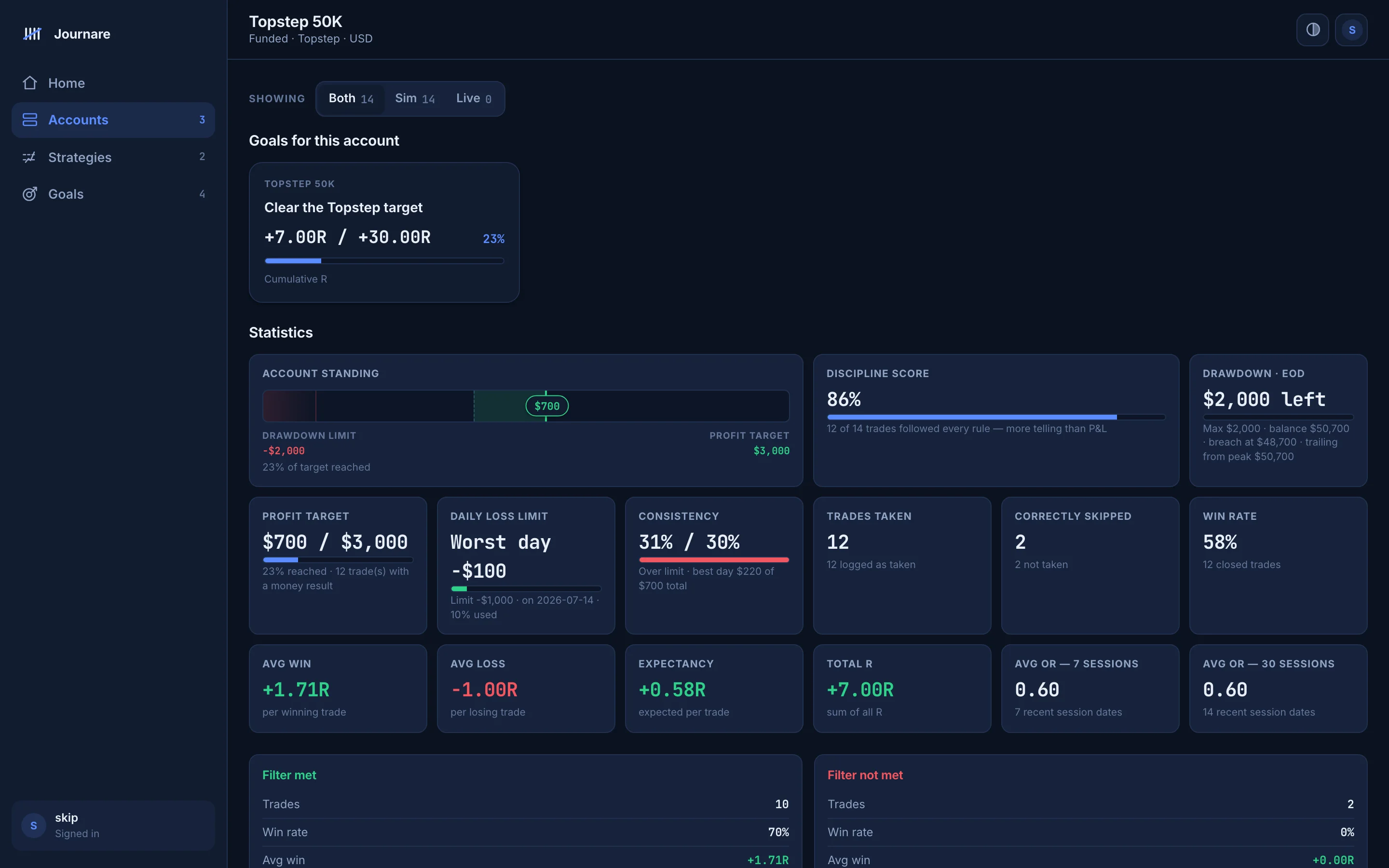
The rulesFive rules that decide whether you keep the account
What each one means, and what Journare does with it. The explanations are here because the terms are genuinely confusing and the firms rarely explain them twice — not because knowing them makes anyone profitable.
Trailing drawdown
A floor under your account that follows your profit upward and never moves back down. The difference that catches people out is when it moves. End-of-day trailing lifts the floor on your closing balance, so an intraday spike you give back does not count. Intraday trailing follows your highest tick, so a trade that runs and reverses tightens the floor permanently. Static drawdown does not follow at all — it sits at a fixed amount below your starting balance.
In Journare: You pick which of the three your account uses and enter the amount. Journare then shows where the floor is now, how much room is left, and the exact balance that would breach it. The Range Meter puts that floor and your profit target on one scale, so you read your position in a glance rather than working it out.
Daily loss limit
The most you may lose in one session before the account is done for the day, or done entirely. Firms differ on the details: some measure it against yesterday's closing balance, some against the balance at the session open, and some count open positions while others only count closed trades.
In Journare: Journare records the result per day and holds your worst day up against the limit you entered. Before you log a trade, the calculator warns you when the position you are about to take could push the day past it.
Consistency rule
A cap on how much of your total profit may come from a single day, usually somewhere between thirty and fifty percent. It exists to stop one lucky session from carrying a whole evaluation. Breaking it usually does not fail the account — it holds up the payout, which is why people discover it late.
In Journare: Journare works out what share your best day carries and flags it when that share is running toward your cap. You see it while there is still time to spread the remainder over more sessions.
Profit target
The amount you have to reach to pass an evaluation or to qualify for a payout. On its own it says little, because what matters is the target relative to how much room you have left underneath you.
In Journare: The target is the ceiling of the same Range Meter that has the drawdown floor at the other end. One scale, both bounds, your net result between them — that relationship is the thing two separate progress bars cannot show.
Max contracts
A cap on how many contracts you may hold at once, often lower during an evaluation than after you are funded. Exceeding it can void a trade or the account, depending on the firm.
In Journare: You set the cap per account and the calculator respects it. When your risk percentage would allow more contracts than the account permits, Journare sizes down to the cap and says it did.